
The Real Secret to Becoming a Better Artist
I used to think there was some secret to “making it” as an artist. When I looked at artists whose work I admired, it seemed as though they had crossed some invisible line that I hadn’t reached yet. Maybe they knew something I didn’t. Maybe they were naturally more talented. Or perhaps they simply had a level of confidence I hadn’t figured out how to find.
Whatever it was, I assumed there was a door somewhere between the artist I was and the artist I wanted to become, and if I kept looking long enough, eventually I’d find it.

Well, I never found the door.
What I found instead, very slowly and then seemingly all at once, was something much less mysterious.
The artists I admired hadn’t “made it” because they possessed some magical combination of talent and confidence. They had simply made a lot of art.
They kept showing up when the work was going beautifully, but more importantly, they kept showing up when it wasn’t. They made things that felt clunky and unfinished. They experimented with ideas that didn’t work. They kept going when nobody was watching and when they weren’t entirely sure where any of it was leading.
Eventually I realized the secret sauce wasn’t much of a secret at all.
It’s consistency mixed with curiosity and a willingness to experiment.
You Don’t Have to Know Where You’re Going
I think this is where we sometimes make creating art harder than it needs to be.
We want to know something is going to work before we’re willing to try it.
We have beautiful papers we’ve spent hours creating, and suddenly they’re too precious to tear. We start arranging a collage and become afraid to glue anything down because what if we put it in the wrong place? We make something we don’t particularly like and decide maybe we don’t know what we’re doing after all.
But what if not knowing what we’re doing is actually part of it?
I’ve taught thousands of artists over the years, and the people I’ve watched transform the most aren’t necessarily the ones who begin with the most natural talent.
They’re the ones who keep arriving.
Week after week. Experiment after experiment. Collage after collage.
They’re willing to make something ugly on a Tuesday afternoon simply because they’re curious about what might happen. And then, instead of deciding Tuesday’s ugly collage means they aren’t very good at this, they come back on Wednesday and make another one.
That’s where things start to change.
Your Beautiful Art Supplies Are Meant to Be Used
A student once wrote to me because she’d made a collection of collage papers she absolutely loved, but when it came time to tear them up and actually use them, she couldn’t do it. She was afraid she’d ruin them.
I understood immediately.
We’ve all had that beautiful sheet of paper, lovely sketchbook, expensive tube of paint, or treasured art supply that somehow becomes too good to use. We save it for the perfect project, which usually means we don’t use it at all. But here’s what I told her, and what I continually have to remind myself:
You can make more.
Maybe you can’t recreate that exact sheet of paper, but that’s actually part of what makes the process exciting. The next one might be completely different. It might even be better. When we treat our materials as precious, we stop playing. And for me, collage comes alive in the playing. A piece of beautiful paper that gets partially covered isn’t wasted. It’s simply become a layer. Something underneath may peek through, or maybe it disappears completely and affects only what gets placed on top of it.
That’s still part of the artwork.
Give Yourself Permission to Make Something You Don’t Like
This may be one of the hardest things to accept when we’re learning to make art.
Not everything we create needs to be good.
In fact, I’m not sure we can get to the work we really love without making quite a bit of work we don’t.
One of my favorite ways around that pressure is to work small. Instead of sitting down intending to create something frame-worthy, make a tiny 5 x 5 inch collage and call it a warm-up before you even begin.
Don’t glue anything for the first twenty minutes. Move pieces around. Tear something you thought was too beautiful to tear. Put two things together that you’re pretty sure don’t belong together and see what happens.
If you’re feeling stuck, give yourself just one simple guideline. For example, each time you place a new paper, make it noticeably different from the one beside it in size, value, or shape.
Then step back and look, move something, and step back again.
You’re not trying to prove that you’re an artist. You’re simply having a conversation with the materials.
Eventually, You Stop Asking If You’re an Artist
You can faithfully show up in your studio and still spend the entire time trying to avoid making mistakes. You can make art every day while repeating the same safe choices because you already know they’ll work. That’s why I think curiosity belongs right beside consistency.
Consistency gets you into the studio.
Curiosity is what makes you ask, What would happen if…?
What if I tear this instead of cutting it? What if I cover up the part I like best? What if I use a color I normally avoid?
What if I stop trying to make this good and just see where it goes?
Over time, something changes. You begin to trust yourself more, not because you’ve finally learned how to make everything work, but because you’ve learned that you can handle it when it doesn’t.
Maybe that’s the confidence I saw in those artists I admired years ago.
It wasn’t certainty.
It was experience.
Maybe This Is What “Making It” Really Means
I don’t think there is a moment when someone taps us on the shoulder and announces that we’ve officially become an artist.
There isn’t a certain number of pieces we need to sell, exhibitions we need to have, followers we need to collect, or years we need to put in.
Maybe “making it” is much quieter than that. Maybe it’s the moment we stop waiting to feel like an artist and simply start behaving like one.
We get curious.
We experiment.
We make things we love and things we can’t wait to cover up.
And then we come back and do it again.
Somewhere in all of that showing up, the question Am I really an artist? doesn’t feel quite so important anymore.
Creative Sparks
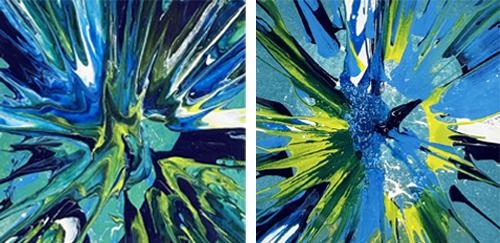
A few things to feed your curiosity and keep you experimenting:
- Salad Spinner Collage Papers Yes, a salad spinner! This is exactly the kind of playful experiment I’m talking about. Take something completely ordinary from your kitchen and see what happens when you bring it into your art studio.
- Glue-and-Go Collage Video If you tend to overthink every placement, this is a completely different way to work. Sometimes committing before you’re certain is exactly what gets the creative energy moving.
Are you interested in learning more about how to incorporate your collage papers into your art?
Check out my Collage Workshops!
*I’ve included affiliates links that pay me for products I share, at no additional charge to you.